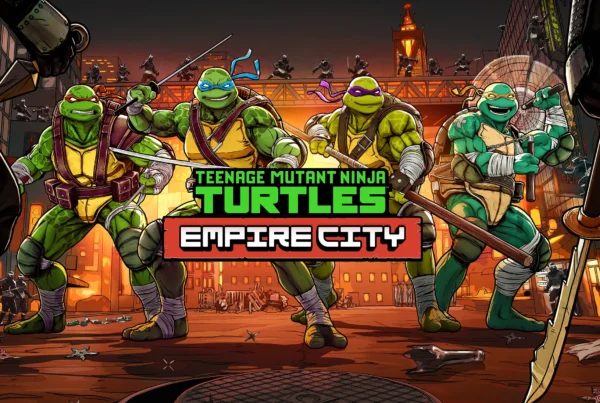
Light, Shadow, and Green – The Art of TMNT: Empire City
by Marcus Fritze, Art Director
When I joined Teenage Mutant Ninja Turtles: Empire City, I’ll admit it: I was overwhelmed. I’d missed the original Turtlemania and thought I had a sense of it, but the universe is massive. Decades of comics, cartoons, movies and games. It’s a lot to take in.
I’ve been in games for 27 years, including nearly twenty at DICE and few at Rovio – often as a lead artist on projects. And while each place taught me something different, being selected as the art director for Cortopia’s latest project is something special. Finding the visual soul of the Turtles in VR has been the most exciting (and terrifying) challenge yet.
In my previous role as a lead artist, I was very hands-on. Fixing, mentoring, and getting my hands dirty with textures and lighting was all in a day’s work. But an art director has to step back. You’re not painting anymore; you’re showing everyone what the painting should look like. My job on Empire City is to define the tone of the game and help the team see the same picture in their heads.


When building our art bible, we looked at other TMNT games to understand what came before – but it’s not where we found our inspiration. That came from the comics, and in particular IDW’s series and the critically acclaimed The Last Ronin. We wanted the game to have weight; to lean into the stakes that the Turtles face every day. Early on, we even toyed with a darker, more mature version, but that didn’t last long. While serious, TMNT isn’t about being grim. It’s about contrast: danger and laughter, shadow and light. They crack a joke even when they’re in over their heads. That balance became our compass.
Translating the comic-book look into VR took some trial and error. We tried outline shaders that looked great in screenshots but fell apart in motion. Eventually we landed on a mix of graphic surfaces for clarity and lighting for depth and mood. Lighting is everything. It shapes where players look and how a room feels. In our game it also defines stealth: light means you’re exposed, dark means you’re safe. It’s simple, but it works.
For the city, we wanted the essence of New York. To achieve this, we mixed buildings and streets of our invention with spots inspired by actual places: Confucius Plaza, the Manhattan Bridge, and spots only locals would know, like the soccer pitch adjacent to it. Even random rooftops are inspired by real spots you can find on a map. We compress space to keep it fun in VR, but it still needs to feel like the city stretches far beyond what you can see.
The same approach applies to the characters. They should feel instantly familiar, but with our own fingerprint. Shredder’s crew looks like you remember them, just through our lens. We also got to expand in areas where the lore is thin. A key character we haven’t revealed yet only has one piece of reference art in the entire Turtles history, so we got to imagine the rest to fill in the blanks. And new twists on existing enemies, like Mousers that can fly? They’re chaos in motion. There’s even a Giant Flying Mouser that feels straight out of a kaiju movie. My personal favorite design, though, is Rocksteady. Everything about him – the bulk, the silhouette – just fits.


VR brings a lot of creative constraints, but I’ve learned to love them. At DICE we could throw polygons at anything. At Rovio we learned to ask what’s actually necessary. That mindset’s perfect for VR. Everything has to earn its place. If it doesn’t help tone, stealth, or story, it’s out.
We’re also having fun adding personality to the city: graffiti, stickers, little signs of life. New York is messy, exactly like it should be. And maybe a few Swedish Easter eggs, if you know where to look. Nothing obvious, just quiet winks from home. 😉
My main job now is protecting the vision. Every day new ideas show up, and I hold them against that art bible. Does it serve the tone? The humor? The stealth? The city? If not, it doesn’t belong. That’s what being an art director really means: not just making art, but knowing when not to.
I can’t wait for players to step onto a rooftop, see the moonlight, and disappear into the shadows like it’s second nature. Because at that moment, you’re not just playing as a Turtle. You are one.