Sounds of the Sewers
How Analog Tech is Powering the Soundtrack of Teenage Mutant Ninja Turtles: Empire City, with Alex May
When Alex May describes the sound of Teenage Mutant Ninja Turtles: Empire City, he doesn’t start with software, synthesizers, or the kind of digital audio wizardry you’d expect to hear from a game composer in the 21st century. Instead Alex focuses on the hiss. The moment you hear the soul-satisfying “click” of the tape locking into place. The soft, imperfect whisper of a cassette spinning after you push play. The warmth and grit of a ’90s sampler. The tactile fingerprints that analog recording leaves behind.
For Empire City, May has turned the clock back. Not just because he misses the days of scramble to find a pencil to wind the tape back into place, but because it’s the most honest way he knows to express the Turtles.
Alex recently sat down with Turtles enthusiast and industry veteran Jim Squires for a wide-ranging discussion about the sound, spirit, and craftsmanship behind Empire City’s aural identity. What follows is a recap of that conversation (which you can view in its entirety below).
A 13-Year-Old and a VHS Tape (Well-Worn)
When did the Turtles first enter your life, Alex?”
“It arrived at this perfect moment when you’re searching for identity,” May recalls. The 1990 film, which he describes as equal parts earnest, gritty, and delightfully weird, had a lasting impact. Ninjas. Martial arts. Japanese-American themes. A killer soundtrack. “I recorded it off TV onto VHS and paused out the commercials,” he admits. “I watched it nonstop.”
Who is Alex May?
May’s career spans VR arcades in Japan, indie mobile development, and his own studio, Moon Mode. “Mostly games nobody’s heard of,” he jokes, though each built the eclectic toolkit that now fuels Empire City’s bold audio identity.
What were your first thoughts when you were asked to helm the soundscape for a TMNT project?
“Disbelief first. Then excitement. Then a tidal wave of imposter syndrome.”
With a franchise as beloved as TMNT, he explains, everyone has their own “correct” idea of what the Turtles should sound like. “You can’t please all of them. If I think about that too much, it becomes terrifying. So I just focus on doing the work.”
A Sound Without a Single Era
When asked how he approached the sound of Empire City, May reveals he started by re-immersing himself in every past TMNT soundtrack.
“And I mean everything,” he says. “From Trent Reznor to Vanilla Ice and MC Hammer.”
The variety was overwhelming, but also liberating. There was no definitive sound. No singular audio template. What emerged was a philosophy: Don’t imitate. Interpret. Cortopia’s creative director, Ace St. Germain, encouraged him to trust his instincts.
“We’re all children of the late ’80s and early ’90s working on this game,” May says. “So I leaned into the thing that feels most natural to me: ’90s electronica.”
A Sound Shaped by ’90s Electronic Heavyweights
May’s influences read like a curated museum of ’90s electronic culture: Leftfield, Chemical Brothers, The Prodigy, DJ Krush, Future Sound of London, and even the soundtracks of John Carpenter.
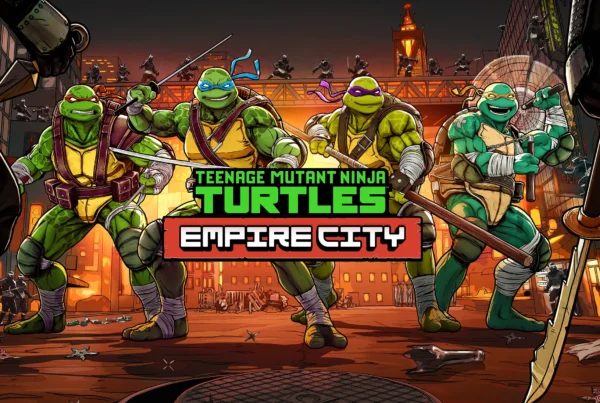
It wasn’t intentional at first, but when paired with Marcus Fritze’s concept art – a style dripping with neon, grit, and urban texture – the connection was undeniable. “It just fit.”
(If you’re interested in getting a taste of the DNA that inspired Empire City’s soundtrack while you wait for the whole thing, May recommends giving these records a spin):
Here’s a single track preview of Port District for Teenage Mutant Ninja Turtles: Empire City.
Mastering to Tape in Modern Era
May’s commitment to capturing that ’90s mixtape feel goes beyond the music itself, extending into how it’s made. Every single track in Empire City is mastered on an old-school audio cassette.
Tapes like these were once the backbone of underground electronic music. Cheap, shareable, and imperfect in all the right ways. “There’s a sacredness to how cassette tape colors electronic sound,” May says. “The bass gets goopy, the highs soften, the hiss becomes part of the texture.” To achieve this, May purchased a modern Tascam deck (one of the few new models still available) and a stockpile of Maxell UR cassettes.
“Every track you’ll hear in the game has lived on tape. You can’t fake that sound.”
The Challenge: Adaptive Game Sound on Analog Tech
Empire City’s design calls for rapid, player-driven transitions between stealth and combat. Scoring that elegantly, especially on cassette, became the biggest speedbump for May. His first attempts were highly systematic: dynamic stems, triggered beats, intricate timing. But it all felt too rigid. Eventually, he found an approach that blended simplicity with emotional clarity:
- A foundational ambient layer always plays
- A rhythmic combat layer kicks in as encounters begin
But because both layers are recorded to cassette separately, they don’t always align. Tape speed fluctuates, timing drifts – things go out of sync almost immediately. And to fix that is no small task.
“I spend hours manually beat-matching tape recordings. It’s incredibly painful. But it’s worth it.”
No Two Turtles Alike, Even in Audio Profile
Lightning Round, Alex: What one word designs the sound design of each Turtle?
- Leonardo: “Confidence”
- Michelangelo: “Humor”
- Donatello: “Structure”
- Raphael: “Aggression”
Bonus round:
- Kermit the Frog: “It’s not easy being green.”
That’s not one word, but we’ll allow it.
What the Soundtrack Will Make You Feel
“If you grew up with the Turtles, this soundtrack will make you feel…”
“…like a teenager.”
Teenage Mutant Ninja Turtles: Empire City is coming later this year exclusively for VR headsets. Wishlist today on Meta Quest and SteamVR.